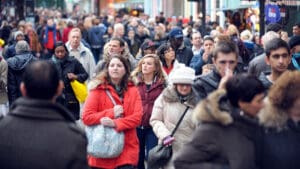
Far from luring shoppers away from the high street, social media is sending them through the door in their millions.
New research from American Express estimates that content scrolled on phones is now behind some 1.7 billion visits to UK high streets every year, an average of more than 30 million a week.
The Hype to High Street study, carried out with analysts Retail Economics, found that nearly two-thirds (63%) of UK adults have walked into a shop or hospitality venue, a café or restaurant among them, in the past year after being swayed by something they saw on social media. Among Gen Z consumers, those aged 18 to 28, the figure climbs to 88%.
It is a striking corrective to the familiar story of the doomed bricks-and-mortar store. For all the talk of declining footfall and shuttered shopfronts, the channel often blamed for emptying the high street is increasingly the reason people turn up at all.
The research suggests social media has become a powerful engine of both footfall and loyalty, particularly among younger shoppers. More than four in five (82%) consumers return to a business after a socially influenced first visit, rising to 96% among Gen Z. They make persuasive advocates, too: nearly eight in ten (79%) say they shared their most recent visit in some way, whether by recommending the business, posting about it or leaving a review online. Among Gen Z, that rises to 89%.
Short-form video is proving especially good at turning online buzz into offline queues. The viral spread of products such as Dubai chocolate and matcha drinks, along with trending venues and experiences, is pushing consumers to seek them out in person.
That points to the emergence of what the study calls a ‘viral pilgrimage’ economy, in which shoppers travel real distances, to other towns and other parts of the country, to get their hands on products, venues and trends first discovered on a screen. More than a third (35%) of Gen Z consumers say they have travelled to another city or region to buy something they first saw trending online. Once there, nearly nine in ten (87%) say they would happily queue for a sought-after product or experience.
It is a behaviour that would have baffled retailers a decade ago, when the rise of live commerce and shoppable video was still a novelty borrowed from Chinese platforms. Today, the journey from a 30-second clip to a physical till is becoming routine.
The findings draw on a survey of 2,000 UK adults, combined with economic modelling used to size the total value and volume of social media-influenced spending on the high street.
Nearly nine in ten (87%) respondents said they spent money during a socially influenced visit, rising to 94% among Gen Z shoppers. More broadly, Retail Economics’ modelling suggests social media now shapes one in every 20 in-person high street purchases across the UK, a measure of how quickly online engagement is translating into real-world spending.
At a time when many high streets are still under pressure, with the British Retail Consortium reporting six consecutive months of falling footfall towards the end of last year, the research suggests the benefits of a socially influenced visit spill well beyond the business that prompted it.
Almost a third (32%) of consumers visited additional nearby shops, restaurants or venues on the same socially influenced trip, while more than one in five Gen Z shoppers (22%) admitted to spending more than they had planned once they arrived. For neighbouring independents, a rival’s viral moment can lift the whole street.
Dan Edelman, UK General Manager, Merchant Services at American Express, said: “Social media has become the new shop window for Britain’s high streets. What starts as a scroll on social is increasingly translating into real-world visits, increased spending and growth opportunity for businesses across the UK.
“What’s striking is that the impact doesn’t stop at the venue that first caught a consumer’s attention, social media is creating a domino effect that benefits neighbouring businesses and helps entire high streets thrive. For merchants, particularly those looking to attract younger consumers, the ability to turn online hype into memorable in-person experiences has never been more important. At American Express, we’re committed to championing the UK’s high streets and the businesses that power them, helping merchants make the most of these changing consumer behaviours.”
Few businesses illustrate the phenomenon better than Randalls, a family-run sweet shop in the East Midlands. After posting a 60-second video of staff packing a customer’s £270 pick and mix order, it watched shoppers arrive from across the country. The clip racked up more than 12 million views, lifting takings and, crucially, the fortunes of the streets around it.
“We’ve always known we had something special, but it was always a local secret. One video changed that overnight,” said Jarrod Burke, founder of Randalls UK. “People started travelling from across the country to visit the shop, including one customer who made a special trip while visiting the UK from Australia. Since the video went viral, our daily takings in-store have tripled, and we’ve regularly had queues outside the shop. What’s been amazing is seeing the impact spread beyond our business too, people are making a day of it in Market Harborough, visiting other independent shops, cafés and businesses nearby.”
For independents wondering how to engineer their own moment, the lesson is less about chasing virality than being ready to convert it, with the basics of how to increase footfall in store mattering just as much as the content that draws people in.
Richard Lim, chief executive of Retail Economics, said the channel’s influence now reaches well beyond e-commerce. “Social media is not just driving online sales, it is now also influencing in-person spend on the UK high street,” he said. “The channel’s growth underlines just how quickly shopping via social has become mainstream, as well as the extent of its positive contribution to the long-term health of UK high streets. Social media is becoming an increasingly important driver of footfall in its own right, helping turn shops, restaurants and venues into destinations consumers actively seek out, visit and share with others.”
The timing matters. With online sales accounting for more than a fifth of total UK retail spending and the high street long braced for the worst, the idea that the feed can fill the street rather than empty it is a welcome shift, and one that hands smaller, nimbler merchants a rare advantage over their larger rivals.
American Express, for its part, has been expanding its own high street presence. Since 2021, the number of UK locations accepting its cards has tripled, taking in more small businesses than ever before, while Amex cards are now accepted at over 170 million merchant locations worldwide as of the end of 2025.
Read full article →