
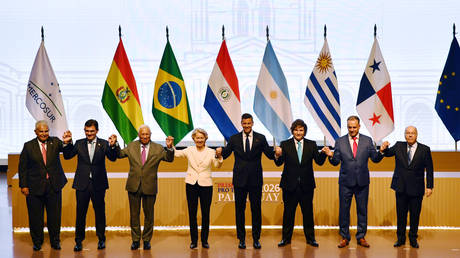
The European Parliament has sent the agreement with South America’s Mercosur bloc for judicial review amid protests
The European Parliament has voted to refer a trade agreement with the South American bloc Mercosur to the EU Court of Justice (CJEU). The move comes amid criticism of Commission President Ursula von der Leyen for bypassing normal EU procedures and widespread protests from farmers across the bloc.
On Saturday, the EU signed a trade pact with Mercosur members Argentina, Brazil, Paraguay, and Uruguay. The agreement, which is projected to create the world’s biggest free trade zone, still requires approval before it can take effect.
On Wednesday, the EU Parliament voted 334 in favor to 324 against, with 11 abstentions, to ask the CJEU to determine whether the deal is compatible with the bloc’s rules. The move now significantly delays the pact that had been negotiated for 25 years, and could potentially derail final approval.
The vote took place against the backdrop of criticism of von der Leyen for handling the Mercosur deal in a non-transparent way, splitting it into separate agreements to bypass national parliaments and reduce the European Parliament’s role to a formal opinion.
Read more
Controversial EU free trade pact signed despite farmer outrage
The deal has also faced widespread resistance from the agricultural sector, with farmers across the bloc staging mass protests over concerns that cheap imports could undercut their livelihoods. The latest rally began on Tuesday outside the European Parliament in Strasbourg and drew support from some lawmakers, continued overnight, and ended on Wednesday.
Von der Leyen had pushed the deal, describing it as a “clear and deliberate choice,” highlighting that the EU opts for “fair trade over tariffs” and “a productive long-term partnership over isolation.” The pact came just six months after she signed an agreement with US President Donald Trump that imposed a 15% tariff on most EU exports. The EC president faced strong pushback over the US deal from current and former EU officials and heads of member states.
The EU is Mercosur’s second-largest trading partner, accounting for nearly 17% of the bloc’s total trade in 2024, at €111 billion.